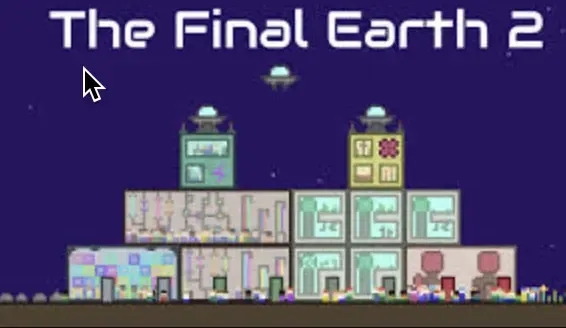
The Final Earth 2: Vertical Space Colony Survival, Layered City Design, and Endgame Expansion
From a single ship on a tiny world to a stacked, self-sustaining space metropolis—The Final Earth 2 is a vertical city builder where “space” is your scarcest resource and stability is your real victory condition.
If you love the clean “one decision shifts the whole system” tension of Sort the Court, The Final Earth 2 delivers that feeling through resource and layout choices instead of dialogue: every building placement affects commuting, production flow, and citizen satisfaction—especially as you grow upward.
What Kind of Game Is The Final Earth 2?
The Final Earth 2 is a futuristic city builder + resource management game developed by Florian van Strien. Earth is unlivable, so you build a space colony, gathering resources and researching toward advanced technology. Over time you can expand beyond your first world by using spaceships and even teleporters.
A key differentiator: it’s designed as a vertical city builder—stacking your colony upward instead of spreading endlessly across a flat map.
The “Unblocked” Reality: Fastest Way to Play in Browser
The developer’s site provides a free web version (noted as “limited content” compared to the full game) and also points to browser portals for easy access.
If you’re specifically searching “The Final Earth 2 Unblocked”, the official page’s portal links are often the most reliable fallback when one host is blocked.
Why Vertical Building Changes Everything
Most city builders punish you for density. The Final Earth 2 rewards it—but only if your structure is legal and your logistics hold up.
The vertical advantage
- Space efficiency: you can grow a large city on a small footprint by stacking layers.
- Readable planning: production chains can be built as “floors” (food below, housing mid, industry above).
- Aesthetic payoff: your colony becomes a visible tower-city instead of a flat sprawl.
The vertical risk
- Support and placement rules can block “greedy” builds.
- Commutes and routing become a silent tax on productivity as cities densify.
🚨 New Player Survival Rule: Stabilize Before You Scale
Most early failures in The Final Earth 2 don’t look dramatic—they look like a slow choke:
- food supply can’t keep up
- housing is mismatched to growth
- production stalls because citizens can’t reach jobs efficiently
- you get stuck in “barely surviving” mode
A practical early priority (works across scenarios)
- Food stability (so growth doesn’t become starvation)
- Housing capacity (so population can expand without chaos)
- Core production (materials needed for the next tier)
- Quality-of-life / happiness infrastructure (so citizens work faster and your colony stops feeling fragile)
This mirrors the game’s own design focus on managing citizen needs as your civilization advances.
Building Placement Rules: “Touching Ground” and Supported Columns
A common beginner frustration is: “Why can’t I build here?”
The Final Earth 2 uses structural placement rules rather than freeform floating builds.
The key concept: supported placement
Many early buildings are placed on open spaces touching the ground as you bootstrap your first settlement.
As you advance, the building system allows more complex structures. Not every building must sit directly on the ground—some can be placed between two supported columns (sandwiched), as long as both supporting sides are themselves connected to ground or a supported structure below.
Practical takeaway:
When a placement fails, don’t brute-force clicks—trace support downward. If the columns aren’t supported, the tile isn’t “real.”
Happiness and Productivity: Why Your City Can Feel “Slow”
Citizen satisfaction isn’t just cosmetic in The Final Earth 2. Higher happiness improves how effectively citizens work (it affects work speed / efficiency), which means your “same city” can produce very different outcomes depending on how well needs are met.
A real-world strategy implication
If you’re scaling production but everything still feels sluggish, the bottleneck might be:
- unmet needs (happiness/amenities)
- commute inefficiency
- poorly placed workplaces vs homes
That’s why veteran play eventually becomes layout + logistics, not “just build more.”
Expansion: Ships, Multiple Worlds, and Teleporters
The game explicitly supports expanding beyond your initial world:
- You can fly to other worlds with spaceships
- You can build teleporters for faster movement and smarter city-wide routing
Strategic mindset shift:
Early game is about survival and stability on one world. Mid/late game becomes a network problem: multiple worlds, transportation choices, and efficiency planning.
How Many Buildings and Systems Are There?
Depending on version and platform, the game features dozens of buildings—and multiple sources describe “over forty” buildings to discover and/or “over fifty” buildings to unlock.
The important strategy point isn’t the exact count—it’s that progression continuously unlocks new ways to:
- increase production
- satisfy citizens
- improve movement and logistics
- support vertical expansion
Final Thoughts: The Final Earth 2 Rewards Engineers, Not Spammers
The Final Earth 2 is at its best when you treat it like a systems puzzle:
- keep the basics stable
- build vertically with support in mind
- solve bottlenecks (food, housing, routing) before scaling
- expand to new worlds when your first city becomes structurally or logistically constrained
If you want a browser strategy game where your city feels like a living, layered machine—this is one of the cleanest “vertical city builder” experiences in the genre.
Ready to break ground? Click the button above to start your colony!
The way you have to stack buildings reminds me of a 2D SimCity but in space. Making a functional tower that doesn't look like a mess is a real challenge.