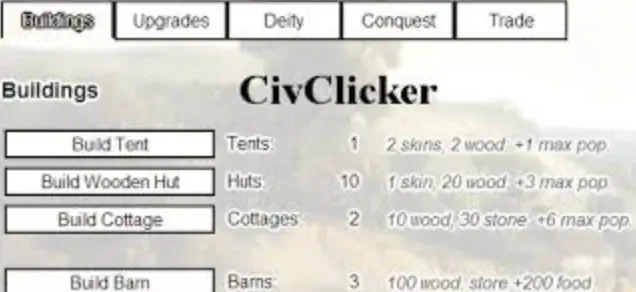
CivClicker: Precision Idle Strategy From Tribe to Wonder Empire (Without the Safety Net)
This isn’t blind clicking. CivClicker is a numbers-tight civilization loop: one unit of food sustains one life, one life becomes labor, and labor decides whether your empire thrives—or starves.
If you enjoy the binary “Yes/No” tension of Sort the Court, CivClicker scratches a different strategy itch: not moral choices, but resource math under pressure. Every decision is a tradeoff between growth, stability, and long-term progress.
What Kind of Game Is CivClicker?
CivClicker is a browser strategy classic that blends idle progression with 4X-flavored management:
- Explore / Expand → grow population and housing
- Exploit / Develop → assign workers to generate resources
- Risk / Recover → manage hunger, illness, raids, and instability
- Commit / Ascend → reset strategically to collect long-term Pantheon progress
The hook is simple: the moment you recruit “too fast,” the game punishes you with the most realistic enemy in strategy games—running out of food.
🚨 The First Law of CivClicker (Read Before You Click More)
Survival beats growth. Always.
A beginner death spiral usually looks like this:
- Recruit too many citizens
- Food can’t keep up
- People starve → productivity drops
- Recovery gets harder → more starvation
- Your civilization collapses into slow, painful stagnation
The safe early priority stack
Food → Housing → Workers → Everything else
If you keep that order, you can scale; if you ignore it, the game teaches you the hard way.
The Core Closed Loop: Why CivClicker Feels “Precise”
CivClicker’s strategy is a closed-loop system. You’re always balancing:
| Loop Layer | Input | Output | The strategic risk |
|---|---|---|---|
| Food | clicks / workers | supports population | hunger triggers collapse |
| Population | food + housing | labor capacity | recruiting too fast kills you |
| Labor | population roles | wood/stone/skins/etc. | misallocation slows progress |
| Trade | surplus resources | gold | gold is scarce early |
| Wonders | resources + time | major progression | rushing can destabilize your base |
| Pantheon | long-run planning | permanent power | reset timing matters |
Think of it as “idle 4X”: your empire grows automatically only if your foundation is mathematically stable.
Resource Roles: Why “More People” Isn’t Always Better
In CivClicker, population only becomes power when you allocate it correctly.
Practical role mindset
- Farmers first until food is always positive
- Add wood/stone production to unlock housing and infrastructure
- Only scale soldiers/army systems when your economy can support them
A stable civilization isn’t the one with the biggest population—it’s the one that can feed that population while still building.
Gold Trade: The Early Wall (and How to Break Through It)
One of CivClicker’s most searched pain points is Gold Trade—because gold can’t be gathered like basic resources.
How gold works (strategy view)
- Traders arrive and offer exchanges: sell a requested resource → receive gold
- Gold becomes a meta-currency used for:
- trade-related improvements
- accelerating key progression steps (notably wonder speed-ups)
- buying resources back in bulk when needed
Gold Trade rule of thumb
Don’t trade away survival resources. Trade surplus.
If trading makes food/housing unstable, the short-term gold gain is never worth the collapse risk.
Wonder Progression: “Wonder Mismanagement” Is Real
Wonders are a major milestone—but they can also be a trap.
The common mistake
Players rush wonder progress while their economy is fragile, then:
- resource flow stalls
- population stability drops
- the entire run slows down harder than if they had stabilized first
Practical wonder guideline
Build wonders when:
- food is stable
- basic resources are consistently positive
- you can absorb short-term shortages without death spirals
Wonders are not “the goal”—they are a stress test for your civilization model.
Pantheon & Resets: Why CivClicker Rewards Multi-Run Strategy
CivClicker’s reset mechanic is not a failure state—it’s a progression system.
The point of resetting
Over multiple runs, you work toward a Pantheon collection—deities and upgrades that turn future runs into more efficient civilizations.
Key mentality shift:
Reset is not “starting over.” Reset is “locking in what you learned—and what you earned.”
What to optimize before resetting
- Did you reach a stable stage you can reliably reproduce faster next run?
- Did your Pantheon progress meaningfully improve your future economy?
- Are you resetting because you hit a wall—or because you’ve completed your run plan?
Cats & Achievements: The “Hidden Depth” That Keeps People Playing
CivClicker isn’t only about resource math. It also has long-term collection goals:
- Cats (mysterious, collectible, widely treated as a long-run completion target)
- Achievements (a progression ledger; some players chase specific challenge-style achievements)
These systems are valuable for a strategy site because they give:
- replay incentives
- structured long-term goals
- shareable “I finally got it” moments
Why CivClicker Is Still a “Browser Strategy Classic”
CivClicker survives because it does something many idle games don’t:
- It makes growth feel earned
- It makes mistakes feel costly
- It turns optimization into identity (“my civ is stable” vs “my civ always collapses”)
- It offers long-run structure through resets and Pantheon progress
If you want a precision idle strategy that feels closer to a civilization simulator than a pure number escalator, CivClicker is the browser classic that still holds up.
Final Thoughts: Build Slow, Win Forever
CivClicker is a game about one idea:
If your foundation is unstable, your empire is temporary.
Start with food. Stabilize. Then scale.
Because in CivClicker, the real victory isn’t clicking faster—it’s building a civilization that doesn’t die when it grows.
Ready to build your empire? Click the button above to play!
The death spiral is real. I recruited 50 workers without checking my food cap and starved half my population in 10 seconds. Lesson learned.